◌̍
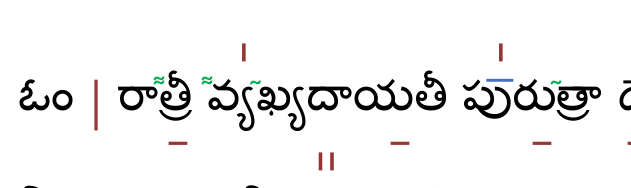
Single stroke above
Above a letter or syllable
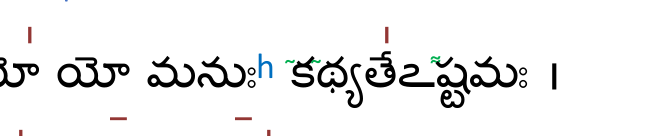
Guide label: Udātta; raised pitch.
The red stroke is separate from ordinary IAST spelling. Placement must be checked on the actual syllable.
 View full source page ↗
 View full source page ↗
A visual reference to the colors, accents and boundaries found in your IAST and Telugu chanting editions. Compare actual source samples before deciding how a mark should appear in the reader.
Both editions contain Sanskrit: IAST uses Latin transliteration; Telugu uses Telugu script. These are script editions, not different translations.
One color can serve several roles. Rare exceptions also occur: one extracted single-wave character is blue (#0070C0) and one gray (#A5A5A5). They must not be automatically recolored green. The source crop establishes the exact occurrence; position and neighboring text must also be considered.
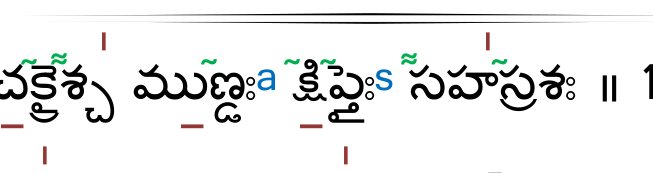
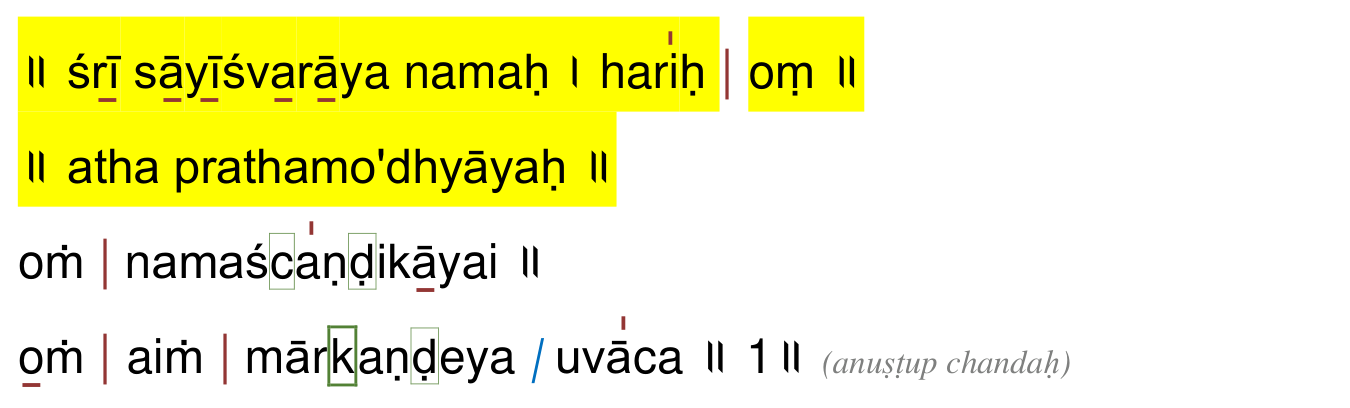
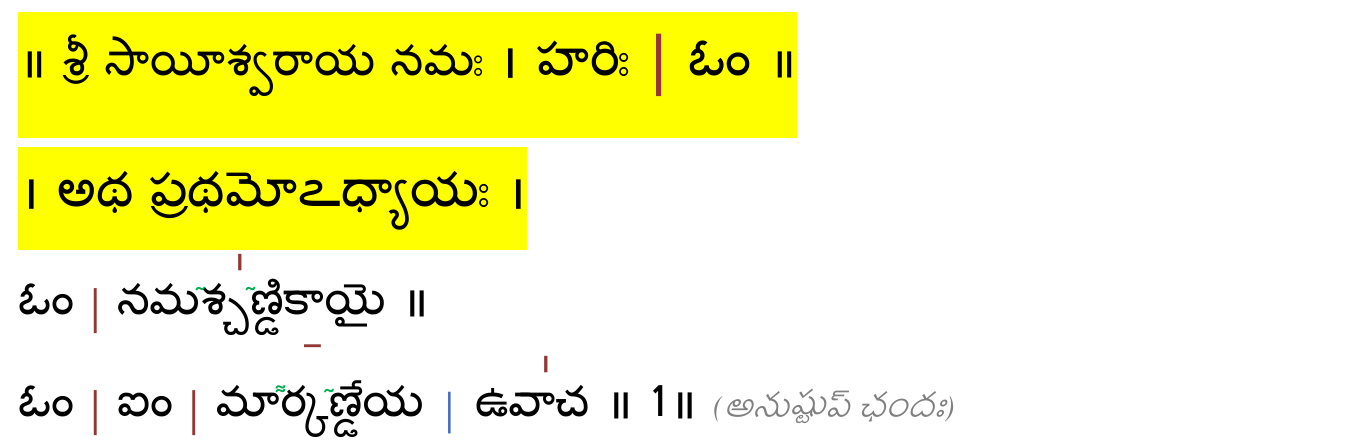
The sampled passages support thin IAST box ↔ single Telugu wave and heavier IAST box ↔ double Telugu wave. This paired Mārkaṇḍeya example shows both. Full-document alignment remains to be checked.
 View full source page ↗
 View full source page ↗
The current extraction finds about 7,200 single waves and 3,300 double waves in Telugu. These are character counts, not counts of unique chanting instructions. The supplied slide’s frequency estimates differ.
Look above and below the letters: red strokes, green cues and blue overlines can coexist. These samples show the notation density; the two crops cover different amounts of text because the editions have different layouts.
 View full source page ↗
 View full source page ↗
Each entry includes its position and source evidence. Click a sample to enlarge it, or open its full page. A missing extraction match is stated explicitly.
Above a letter or syllable
Guide label: Udātta; raised pitch.
The red stroke is separate from ordinary IAST spelling. Placement must be checked on the actual syllable.
View full source page ↗View full source page ↗Below a letter or syllable
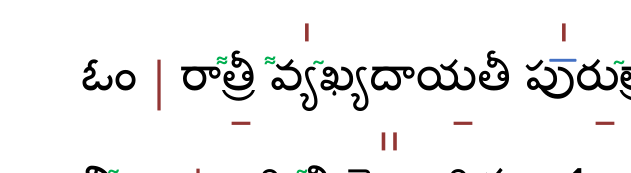
Guide label: Anudātta; lowered pitch.
Keep the lower bar distinct from an ordinary vowel macron and a blue overline.
 View full source page ↗
 View full source page ↗
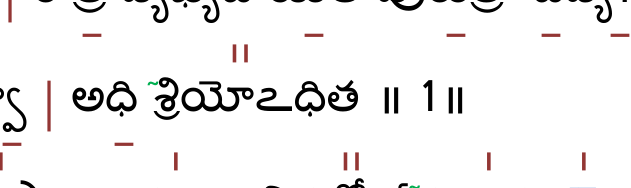
Above; may coexist with other marks
Guide label: Dīrgha udātta; prolonged raised pitch.
The name and pronunciation description are from the supplied guide; teacher review remains separate.
 View full source page ↗
 View full source page ↗
Telugu: above text • IAST: box around a letter/cluster component
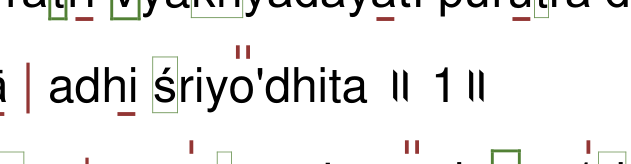
Guide label: Svarita; falling pitch.
Sampled passages support thin box ↔ this wave. IAST boxes use approximately #538135. The document-wide mapping is not yet verified.
 View full source page ↗
 View full source page ↗
Telugu: above text • IAST: box around a letter/cluster component
Guide label: Kampita svarita; quavering pitch.
Sampled passages support heavier box ↔ this wave. IAST boxes use approximately #538135. The document-wide mapping is not yet verified.
 View full source page ↗
 View full source page ↗
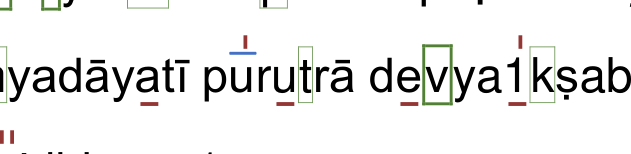
Above a syllable, sometimes stacked with red marks
Guide describes a lengthening cue.
Preserve the blue overline separately from the red stroke that may share the same location.
 View full source page ↗
 View full source page ↗
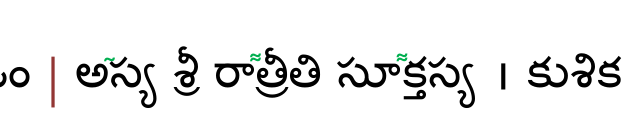
Between words, phrases or at a boundary
Colored boundary / pause cue; scope must be established from the passage.
Do not treat every vertical bar as a stroke above a syllable, or assume all colors have the same function.
 View full source page ↗
 View full source page ↗
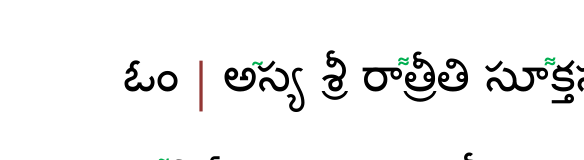
Between words, phrases or at a boundary
Colored boundary / pause cue; scope must be established from the passage.
Do not treat every vertical bar as a stroke above a syllable, or assume all colors have the same function.
No matching character found by this extraction. This does not establish visual absence.
No matching character found by this extraction. This does not establish visual absence.
Between words, phrases or at a boundary
Colored boundary / pause cue; scope must be established from the passage.
Do not treat every vertical bar as a stroke above a syllable, or assume all colors have the same function.
 View full source page ↗
 View full source page ↗
Between words, phrases or at a boundary
Colored boundary / pause cue; scope must be established from the passage.
Do not treat every vertical bar as a stroke above a syllable, or assume all colors have the same function.
 View full source page ↗
No matching character found by this extraction. This does not establish visual absence.
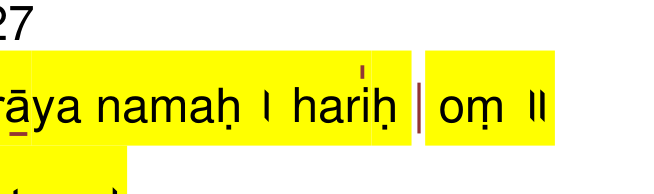
At a textual boundary
Standard Sanskrit punctuation; often a half-verse boundary.
Its exact structural role depends on the passage. Keep it separate from a colored Latin vertical bar.
 View full source page ↗
 View full source page ↗
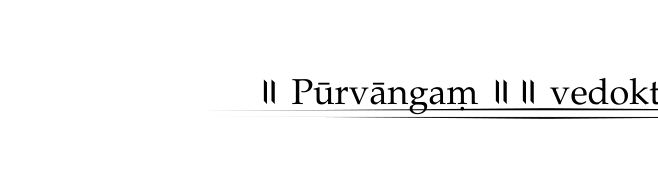
End of a verse or textual unit
Standard Sanskrit double daṇḍa, often next to numbering.
Preserve numbering and source punctuation exactly.
 View full source page ↗
 View full source page ↗
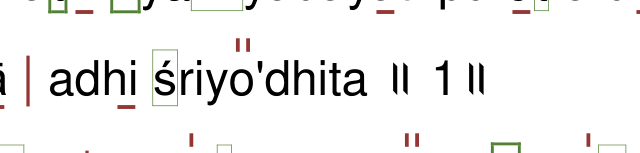
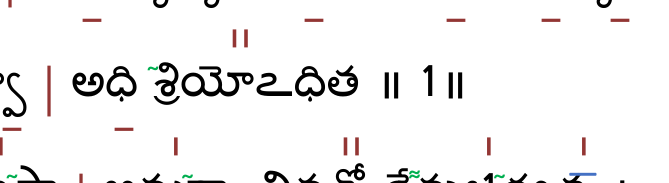
Within joined words
Elision notation; shape differs across scripts and editions.
Do not normalize apostrophes and avagraha forms into one character. This example does not certify every doubled form.
 View full source page ↗
 View full source page ↗
After or near source text
Editorial cue; exact intent is unresolved.
The guide suggests a textual note, but a variant reading must not be inferred without its explanation.
 View full source page ↗
 View full source page ↗
Near the baseline / boundary
Observed low grave accent; interpretation pending.
Retain its exact location. Do not assign duration or pronunciation from its shape alone.
 View full source page ↗
 View full source page ↗
Raised, baseline or adjacent to letters; inspect each occurrence
Nasal cue.
Guide labels are provisional explanations. Not all blue text is superscript, and absence in extraction is not proof of absence.
 View full source page ↗
 View full source page ↗
Raised, baseline or adjacent to letters; inspect each occurrence
Labial nasal cue.
Guide labels are provisional explanations. Not all blue text is superscript, and absence in extraction is not proof of absence.
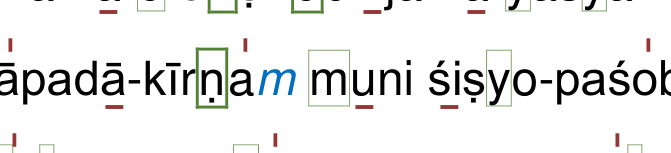 View full source page ↗
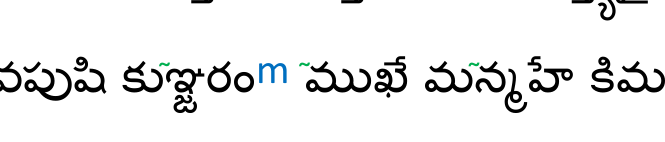 View full source page ↗
Raised, baseline or adjacent to letters; inspect each occurrence
Palatal nasal cue.
Guide labels are provisional explanations. Not all blue text is superscript, and absence in extraction is not proof of absence.
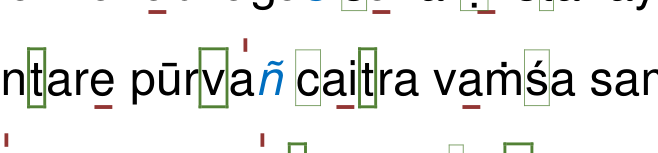 View full source page ↗
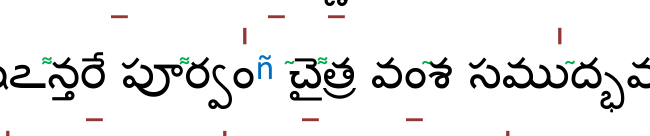 View full source page ↗
Raised, baseline or adjacent to letters; inspect each occurrence
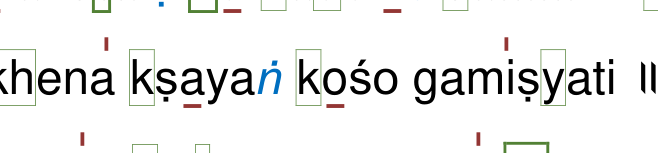
Velar nasal cue.
Guide labels are provisional explanations. Not all blue text is superscript, and absence in extraction is not proof of absence.
 View full source page ↗
 View full source page ↗
Raised, baseline or adjacent to letters; inspect each occurrence
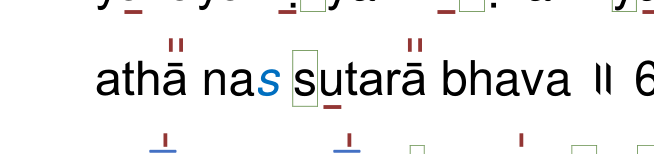
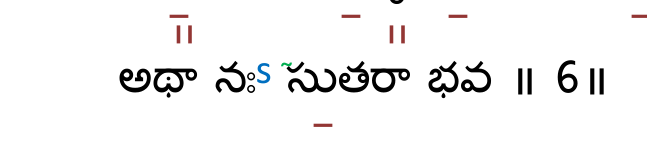
Sibilant / visarga cue.
Guide labels are provisional explanations. Not all blue text is superscript, and absence in extraction is not proof of absence.
 View full source page ↗
 View full source page ↗
Raised, baseline or adjacent to letters; inspect each occurrence
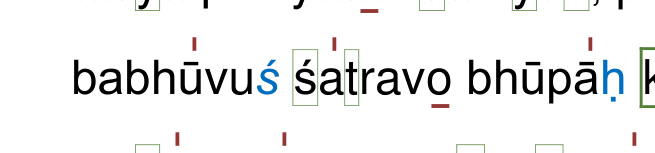
Palatal sibilant cue.
Guide labels are provisional explanations. Not all blue text is superscript, and absence in extraction is not proof of absence.
 View full source page ↗
 View full source page ↗
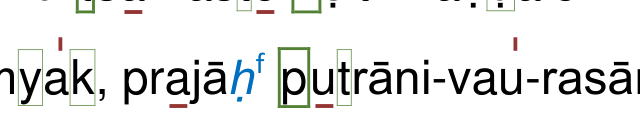
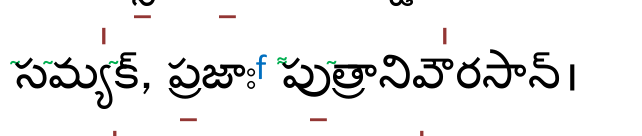
Raised, baseline or adjacent to letters; inspect each occurrence
Guide labels jihvāmūlīya.
Guide labels are provisional explanations. Not all blue text is superscript, and absence in extraction is not proof of absence.
 View full source page ↗
 View full source page ↗
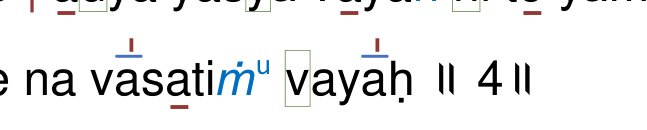
Raised, baseline or adjacent to letters; inspect each occurrence
Guide labels upadhmānīya.
Guide labels are provisional explanations. Not all blue text is superscript, and absence in extraction is not proof of absence.
 View full source page ↗
 View full source page ↗
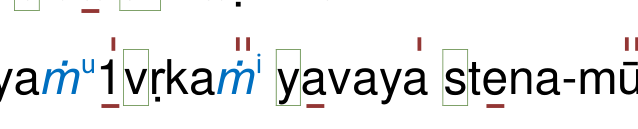
Raised, baseline or adjacent to letters; inspect each occurrence
Guide labels vowel resonance.
Guide labels are provisional explanations. Not all blue text is superscript, and absence in extraction is not proof of absence.
 View full source page ↗
 View full source page ↗
Raised, baseline or adjacent to letters; inspect each occurrence
Guide labels aspiration cue.
Guide labels are provisional explanations. Not all blue text is superscript, and absence in extraction is not proof of absence.
No matching character found by this extraction. This does not establish visual absence.
 View full source page ↗
Raised, baseline or adjacent to letters; inspect each occurrence
Guide labels lateral cue.
Guide labels are provisional explanations. Not all blue text is superscript, and absence in extraction is not proof of absence.
 View full source page ↗
 View full source page ↗
Raised, baseline or adjacent to letters; inspect each occurrence
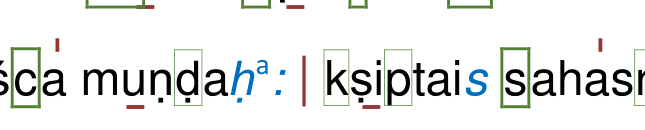
Guide labels elision-related cue.
Guide labels are provisional explanations. Not all blue text is superscript, and absence in extraction is not proof of absence.
 View full source page ↗
 View full source page ↗
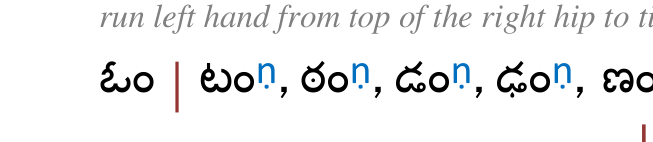
Raised, baseline or adjacent to letters; inspect each occurrence
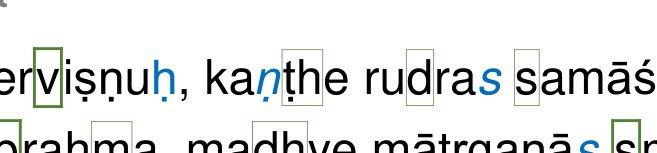
Retroflex nasal cue.
Guide labels are provisional explanations. Not all blue text is superscript, and absence in extraction is not proof of absence.
 View full source page ↗
 View full source page ↗
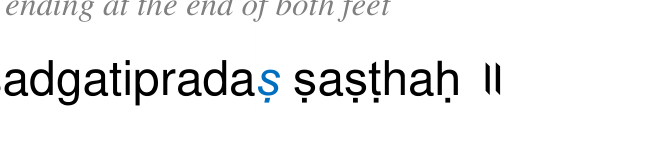
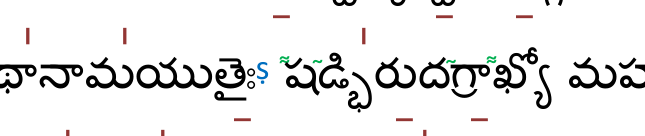
Raised, baseline or adjacent to letters; inspect each occurrence
Retroflex sibilant cue.
Guide labels are provisional explanations. Not all blue text is superscript, and absence in extraction is not proof of absence.
 View full source page ↗
 View full source page ↗
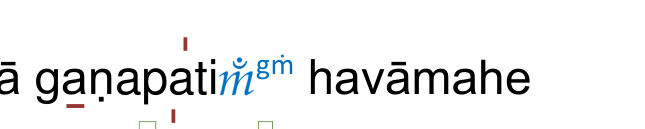
Raised, baseline or adjacent to letters; inspect each occurrence
Not explained in supplied guide.
Guide labels are provisional explanations. Not all blue text is superscript, and absence in extraction is not proof of absence.
 View full source page ↗
 View full source page ↗
Raised, baseline or adjacent to letters; inspect each occurrence
Blue visarga form.
Guide labels are provisional explanations. Not all blue text is superscript, and absence in extraction is not proof of absence.
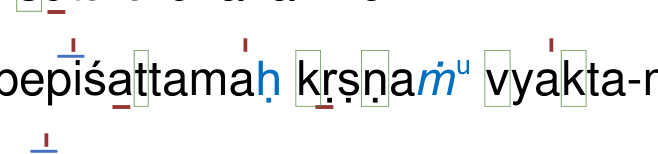 View full source page ↗
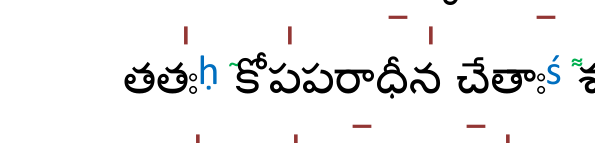 View full source page ↗
Raised, baseline or adjacent to letters; inspect each occurrence
Blue nasal form.
Guide labels are provisional explanations. Not all blue text is superscript, and absence in extraction is not proof of absence.
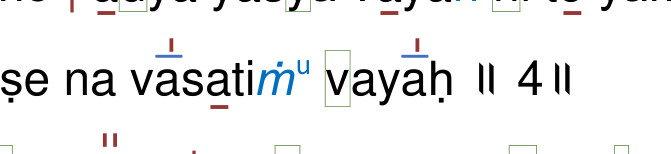 View full source page ↗
 View full source page ↗
Raised, baseline or adjacent to letters; inspect each occurrence
Blue nasal form.
Guide labels are provisional explanations. Not all blue text is superscript, and absence in extraction is not proof of absence.
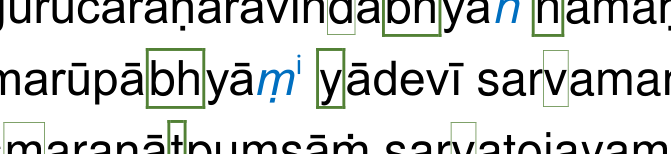 View full source page ↗
No matching character found by this extraction. This does not establish visual absence.
No confirmed visible extent
Telugu page 11 contains an extracted U+E001 with zero width.
No visual symbol or chanting meaning is assigned. The crop provides context only; the question mark here is an interface placeholder.
No matching character found by this extraction. This does not establish visual absence.
No matching entries. Try another word.
Yellow invocation blocks, gray instructions, punctuation, word gaps and original line endings also belong to the edition. A mark between words must remain anchored to that boundary. Search-friendly text must be kept separately from faithful source appearance.
 View full source page ↗
 View full source page ↗
Sources: DM full - IAST SB-Master.pdf (157 pages), DM full - Telugu SB-Master.pdf (175 pages), and Devi_Mahaatmyam-Annotation_Slides.pptx (2 slides). Original files are unchanged and checked against the saved SHA-256 manifest.
Generated crops use PyMuPDF 1.26.5. Some source fonts are not embedded; rendering must still be compared with your accepted reading copy. Selected pages were visually checked; individual automatically selected catalog crops need review. No chanting interpretation is inferred solely from Unicode names.
Special open issues: blue g, low slanted accents, the asterisk’s intent, private-use character, rare color variants, and precise cross-edition syllable anchors. The complete Rātrisūktam remains the first fidelity pilot.
Source page and crop coordinates